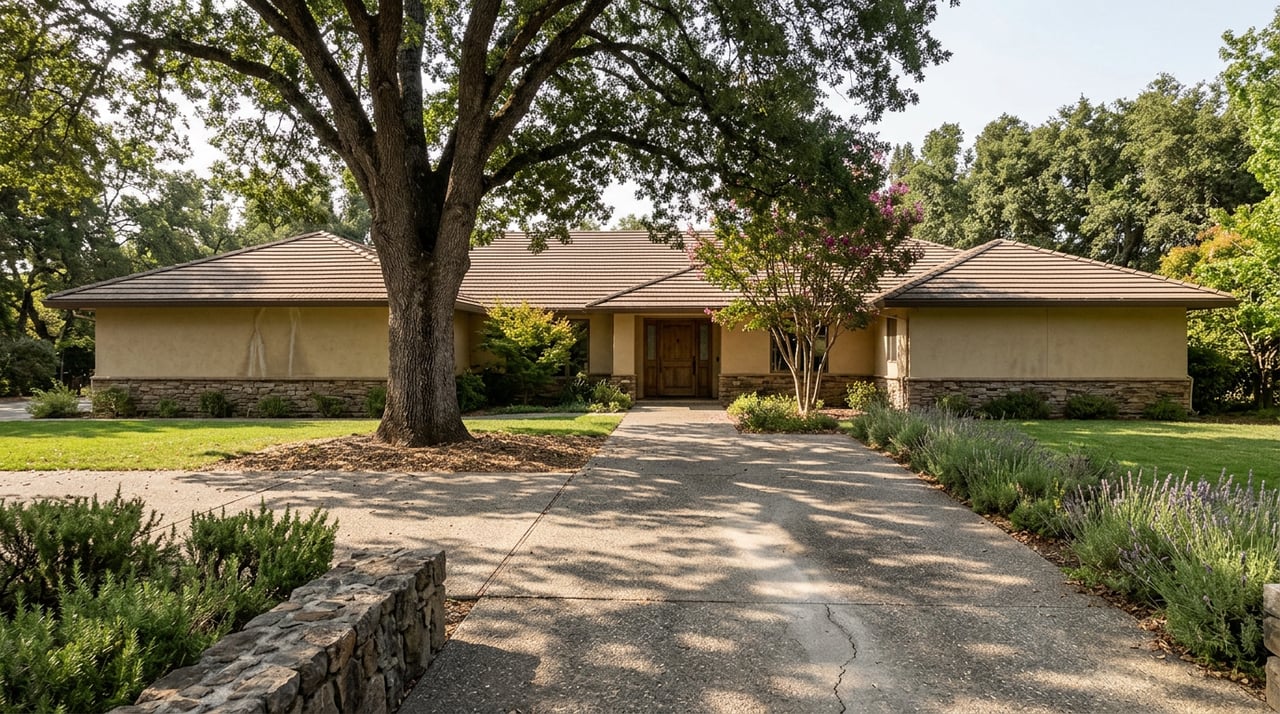
A successor trustee opens the mail and finds a completed Inventory and Appraisal, Judicial Council Form DE-160, listing a dollar figure for the Granite Bay house their parent left behind. It looks official because it is. A court-appointed referee signed it. Most people in this position do the reasonable thing: they treat that number as what the house is worth and start planning around it.
That assumption is usually wrong, and in Granite Bay it tends to be wrong in a specific, expensive way. The referee's figure and the county's own paperwork requirements both move on schedules that have nothing to do with the local market or a typical escrow calendar. Understanding what each number actually measures, and what it doesn't, changes how an executor should price the sale and how much lead time they need before they ever put a sign in the yard.
The Referee Doesn't Work for the Market
California probate referees are appointed by the State Controller's Office, not chosen by the executor or the family. Placer County is currently assigned one referee, Marlee C. Anderson, though referee assignments rotate and should always be confirmed directly with the Controller's Office before relying on a name. Under Probate Code sections 8901 through 8909, the referee values everything in the estate except cash, checking and savings balances, and money market funds. Real property falls squarely in the referee's lane.
The appraisal standard is fair market value as of the date of death, not the date the house eventually lists. Referees carry heavy caseloads across an entire county, and in practice many valuations happen from the curb rather than through an interior walkthrough. That's not a flaw in the system. It's a fast, low-cost way to establish a defensible baseline for estate administration. It was never built to price a listing.
That distinction matters because of what the referee's number is used for versus what it can't tell you:
- What it does: provides a baseline for the estate.
- What it doesn't do: account for a kitchen that hasn't been touched since the Reagan administration, a septic system nearing the end of its service life, or the fact that the same square footage in a gated community with an active HOA behaves differently in front of buyers than an identical house on an open street.
Why the Gap Is Wider on an Estate-Sized Granite Bay Lot
That gap between a legal number and a market number widens on the kind of property Granite Bay tends to produce. The average single-family home in the 95746 ZIP code runs roughly 38 years old on public assessor and MLS data compiled in late 2025, and a meaningful share of the community's larger parcels sit in unincorporated Placer County on private septic rather than a municipal sewer connection. A drive-by valuation can note the roofline and the landscaping. It has no reliable way to flag a leach field near capacity or a tank that hasn't seen a pump truck in half a decade.
Layer in Granite Bay's gated communities, places like Wexford, Los Lagos, and Shelborne Estates, and there's a second condition-and-compliance question a curb view can't answer: what the HOA's CC&Rs require before any exterior work, listing signage, or even a for-sale showing schedule can proceed.
Meanwhile the actual market moves in a range, not a single fixed figure. Closed sales of single-family homes in the 95746 ZIP through the first half of 2026 put the median price at $1,265,000, essentially flat against the same period in 2025, while the average sale price rose closer to $1.42 million as price per square foot held steady near $432. The most competitive segment sat between $1.2 million and $1.5 million, where 57 percent of homes sold above list price and 43 percent went under contract within a week. Outside that band, homes needing work took considerably longer to find a buyer.
That's the real contrast. The referee produces one static, backward-looking number. The market produces a range that shifts by price tier and condition, and an estate-sized Granite Bay property with deferred maintenance or an aging septic system doesn't automatically land in the tier that sells fastest.
The Septic Clock Nobody Puts on the Calendar
Even after an executor sorts out pricing, Placer County's own process for confirming a septic system's condition can quietly consume weeks that a normal escrow timeline doesn't budget for. Placer County Environmental Health won't open a transfer evaluation file until it has a pumper's report showing the tank was serviced within the past three years. If the last pump-out happened longer ago than that, and on a property that's been sitting in an estate for months or years, it often has, that service has to happen first. Only then can the evaluation itself be requested.
Once the file is open, the county's evaluation looks at the tank's minimum capacity and physical condition, whether there are warning signs like surfacing effluent or unusually lush vegetation over the leach field, and whether there's verified replacement area available if the system ever needs repair. None of that can start until the pump-out prerequisite is satisfied, which means the real bottleneck usually isn't the inspection itself. It's the fact that step two can't be scheduled until step one is complete, and step one is a separate service call most executors don't think to make on day one.
Placer County did overhaul parts of its septic program in the second half of 2025, updating the Local Agency Management Program to lower installation costs and simplify rules for new systems and additions like ADUs. Those reforms addressed new construction and system upgrades.
This isn't unique to Placer County. A KDS Homebuyers article reports that Sacramento, El Dorado, and San Diego counties impose similar local septic requirements. Those requirements sit on top of California's disclosure obligations under the Transfer Disclosure Statement. It bites hardest in Granite Bay simply because so much of its estate-sized acreage runs on private systems rather than sewer.
What This Means If You're the One Signing
If the personal representative has full authority under the Independent Administration of Estates Act, the sale can generally proceed without a court confirmation hearing, and there's more room to price the house to the market band it actually competes in rather than the referee's figure. If full authority wasn't granted, the referee's number becomes more than informational.
Either way, the practical move is the same: request the property's septic pump-out history the day the assignment starts, not the week escrow is supposed to open. If the parcel sits inside a gated community, pull the CC&Rs and HOA financials early enough that architectural review can run alongside the county process instead of stacking behind it. And treat the referee's DE-160 figure as the legal number it is, while getting an independent read on what the specific lot, system, and condition will actually bring from a buyer.
That's the coordination work an estate rarely has bandwidth to do alone, particularly when the personal representative is managing this from another state or juggling several open matters at once. It's also the specific gap Cooper Realty is built to close for Northern California fiduciaries, attorneys, and out-of-state heirs: reviewing title and equity, flagging condition and compliance issues before they surface mid-escrow, and keeping the referee's timeline, the county's septic process, and the actual market moving on the same calendar instead of three separate ones.
A Few Questions That Come Up Often
Does every probate sale in Granite Bay require court confirmation? No. If the personal representative was granted full authority under the Independent Administration of Estates Act, the sale can typically close without a confirmation hearing. Confirmation and the overbid process apply when that full authority wasn't granted or when the will restricts the representative's power to sell.
Can an executor get a second opinion alongside the probate referee's appraisal? Yes, and it's common practice. The referee's figure serves the court's purposes. Many executors also obtain a current market appraisal or a real estate professional's opinion of value before setting a list price, particularly when the property has condition issues a drive-by valuation wouldn't catch.
If you're managing a Granite Bay estate and want to know where a specific property likely falls before you commit to a timeline, Cooper Realty offers a free consultation to walk through the property, the paperwork already in hand, and what needs to happen before it ever reaches the market.
This article is general information, not legal, tax or financial advice. Consult a qualified professional about your situation.